Fix Office Fatigue: Practical Daily Habits to Reverse Long-Sitting Body Damage

In the digital work era, sedentary desk work has become the mainstream lifestyle for countless professionals. From daily office work to remote home offices, most people spend 8 to 12 hours sitting in front of electronic screens every day. This long-term static working mode does not cause immediate physical pain, but it slowly erodes bodily health, triggers persistent physical fatigue, poor body posture, and declining physical vitality. Many office workers attribute physical soreness and mental sluggishness to work tiredness, ignoring that most sub-health problems stem from uncorrected sedentary habits. Fortunately, with simple, time-efficient, and office-friendly adjustment methods, everyone can effectively relieve sedentary strain, repair physical discomfort, and maintain long-term bodily health and vitality.
The Invisible Bodily Damage Caused by Long-Term Sedentary Work
Prolonged sitting is one of the most overlooked causes of modern sub-health. Unlike strenuous exercise that consumes physical strength, static sitting keeps the human body in a fixed compressed state for a long time, leading to a series of chain reactions in muscles, joints, circulation and metabolism.
First, it destroys upper body muscle balance. Long-term desk work keeps the neck and shoulders in a forward-tensed state for hours. The cervical muscles remain contracted, the chest muscles are compressed, and the upper back muscles are continuously stretched. Over time, this leads to forward head posture, rounded shoulders, tight trapezius muscles, and recurring neck and shoulder stiffness. Mild discomfort will gradually evolve into chronic muscle strain, affecting daily comfort and work state.
Second, it causes severe lower body and lumbar pressure. Sitting for a long time increases spinal compression, flattens the natural physiological curvature of the lumbar spine, and triggers persistent waist soreness and numbness. Meanwhile, long-term hip compression shortens hip flexors, inactivates gluteal muscles, and slows lower limb blood circulation, resulting in leg swelling, joint stiffness, and overall body heaviness after work.
In addition, continuous static sitting reduces human basal metabolism. Long-term lack of physical activity slows down gastrointestinal peristalsis and energy consumption, making people prone to drowsiness, poor concentration, physical fatigue and low immunity, forming a vicious cycle of sedentary sub-health.
Hidden Bad Office Habits That Aggravate Physical Strain
Most people’s sedentary physical problems are not caused by working too hard, but by accumulated trivial bad habits in daily work. These inconspicuous behaviors continuously increase body pressure and accelerate physical aging and strain.
Working uninterrupted for several hours is the most common bad habit. Many professionals focus on work tasks and refuse to take short breaks, keeping the body in a static tense state for a long time, resulting in continuous accumulation of muscle tension and metabolic stagnation.
Improved screen viewing posture is also a key factor of strain. Leaning forward to stare at the screen, lowering the head for a long time, and twisting the body unconsciously will cause asymmetric spinal pressure and aggravate cervical and lumbar fatigue.
Besides, habitual leg crossing, single-sided hip sitting, and hunching while typing will disrupt the body’s force balance, cause pelvic tilt and muscle tension difference on both sides, and form irreversible bad posture over time.
Easy Ergonomic Adjustments for Long-Hour Desk Work
Scientific ergonomic adjustment is the most fundamental way to reduce sedentary damage. Reasonable desk and sitting posture configuration can evenly disperse body pressure, reduce muscle and joint load, and greatly relieve daily office fatigue.
Adjust the display screen to eye level to ensure the neck is in a natural straight state, avoiding long-term neck bending and forward stretching. Keep the keyboard and mouse at elbow height to prevent shoulder lifting and arm tension caused by improper operating height.
Keep the lumbar spine naturally supported, maintain a slight physiological curvature of the lower back, and avoid complete slumping of the body. Distribute the hip force evenly on the chair surface, keep the knees at 90 degrees, and place both feet flat on the ground to ensure smooth lower limb circulation and stable body force.
Keep the upper body relaxed, shoulders naturally drooping, chest slightly open, and spine straight. This standard sitting posture can effectively reduce more than half of the sedentary muscle strain and protect spinal health for a long time.
5 Zero-Equipment Office Stretches for Instant Fatigue Relief
These ultra-practical stretching movements are designed for office scenarios, with no equipment, no noise and no extra space required. They can quickly relieve local muscle tension in 2-3 minutes and are suitable for frequent practice during work gaps.
1. Chin Tuck Cervical Correction: Sit upright, slowly retract your chin backward, keep the neck stretched straight, hold for 20 seconds and repeat 3 times. This movement effectively corrects forward head posture, relieves cervical compression, and eliminates neck stiffness caused by long screen watching.
2. Seated Chest Opening Stretch: Straighten your back, open your arms to both sides, and expand your chest backward gently. Stay for 15 seconds each time. It can stretch tight chest muscles, improve rounded shoulders and hunchback, and relieve upper body stuffiness and heaviness.
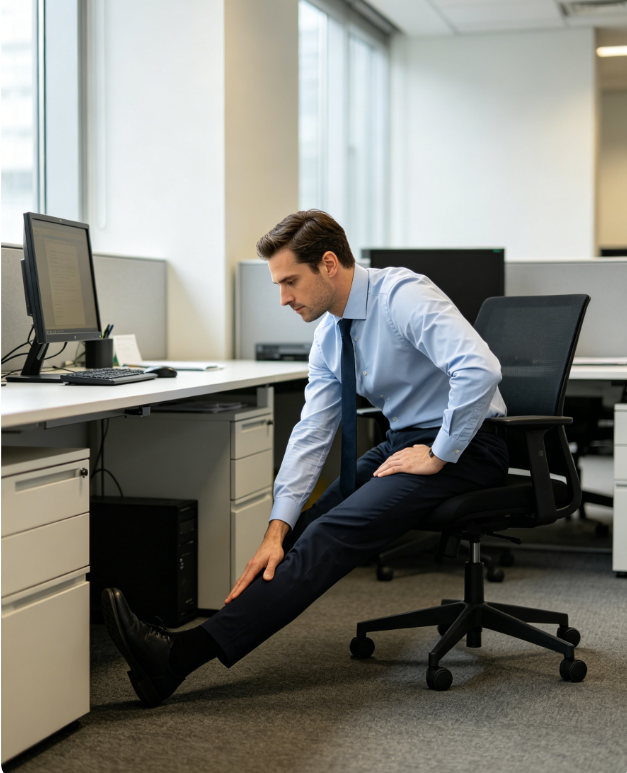
3. Lumbar Spine Relaxation Stretch: Sit on the edge of the chair, straighten your upper body, and lean forward slowly with your back straight. Feel the stretching of the lumbar and back muscles, hold for 20 seconds. This perfectly relieves lumbar muscle spasm and soreness caused by long-term sitting compression.
4. Seated Hip and Leg Stretch: Cross one leg over the other, press the knee gently downward, and lean the upper body forward slightly. Fully stretch the hip and outer thigh muscles on the stretched side to improve hip stiffness and poor lower limb circulation.
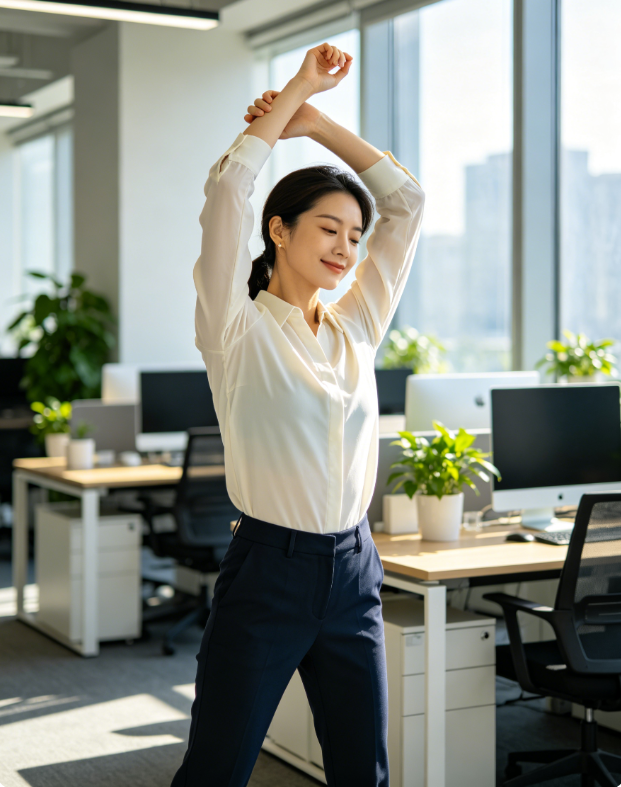
5. Full Body Micro-Stretch: Stand up straight, raise your arms upward, stretch your whole body upward, and tiptoe gently while taking deep breaths. This movement relaxes the compressed spine, activates whole-body circulation, and instantly relieves overall physical fatigue.
Scientific Work-Rest Schedule to Avoid Sedentary Accumulation
Single stretching cannot completely offset sedentary damage. Building a fixed scientific work-rest rhythm is the core of long-term office health maintenance.
Follow the 30-minute micro-adjustment rule: every 30 minutes of sitting work, adjust your sitting posture, move your shoulders and neck, and look into the distance to relax muscles and eyes, avoiding continuous tension accumulation.
Stand up and move for 2-3 minutes every hour. You can walk around the office, fetch water, or simply stretch your limbs to break the long-term static state of the body and restore blood circulation and muscle vitality.
Make full use of lunch break for rest and relaxation. Do not keep sitting and working during the break. Proper standing walking and stretching can completely release morning physical fatigue and lay a foundation for efficient work in the afternoon.
Daily Auxiliary Habits to Improve Sedentary Sub-Health
Daily living habits determine the repair efficiency of sedentary physical damage. Keeping adequate water intake every day can accelerate blood circulation and metabolic waste discharge, effectively relieving muscle stiffness and body edema caused by inactivity.
Avoid staying seated for a long time after work. Arrange 10-15 minutes of walking, jogging or gentle stretching every night to activate the inactive muscles of the day, improve physical metabolism, and eliminate accumulated fatigue.
Maintain a regular work and rest schedule. Sufficient and high-quality sleep allows strained muscles and spine to repair fully at night, reducing chronic soreness and physical sub-health problems. At the same time, appropriately reduce screen time after work to avoid secondary damage to cervical muscles.
Conclusion
Long-term sedentary desk work is an inevitable part of modern professional life, but all sedentary-induced physical discomfort and sub-health problems are reversible and preventable. The root causes of office fatigue, poor posture and physical stiffness are long-term static inertia, incorrect sitting posture and irregular work-rest rhythms.
By adhering to scientific ergonomic sitting posture, insisting on simple zero-equipment office stretching, forming a regular work-rest schedule, and matching healthy daily living habits, every desk worker can effectively resist sedentary damage, improve physical vitality, maintain healthy spine and muscle state, and realize a balanced state of efficient work and healthy body.