Renter-Friendly DIY: Craft Reusable Layered Furniture Shims for Uneven Japanese Apartment Floors
Introduction
A considerable number of older Japanese rental apartments feature uneven wooden flooring and warped floorboards caused by long-term humidity and building aging. Heavy furniture such as beds, cabinets, and desks often tilts slightly, producing unstable shaking and abnormal squeaking sounds. Furthermore, the zero-clearance gap between furniture legs and the floor creates inaccessible dust corners that cannot be cleaned by robotic vacuum cleaners. Since tenants are prohibited from replacing floorboards, nailing fixed supports, or permanently altering furniture height, uneven flooring remains an unsolvable trouble for most renters. Under such physical and contractual limitations, a handmadelayered furniture lifting shim provides a low-cost, reversible solution. Composed of stacked soft hardboard and shock-absorbing materials from 100-yen stores, this detachable tool levels shaky furniture, raises clearance height, and protects fragile wooden floors. Beyond mechanical stabilization, this simple handmade shim reflects the quiet Japanese living philosophy: subtly balancing imperfection rather than completely eliminating it.
Design Concept of the DIY Shim
Unlike single-thickness commercial plastic pads with fixed heights, this handmade furniture shim adopts a stacked modular structure specially designed for irregular Japanese rental floors. It follows three renter-oriented design principles: adjustable thickness, scratch-free contact, and fully reusable assembly. Old wooden floors are easily dented under long-term pressure; thus, the composite material disperses weight to prevent permanent indentation. Instead of forcibly flattening uneven ground, this layered shim fills height differences to create an artificial horizontal balance. Its plain neutral color also blends naturally with indoor furniture without breaking the minimalist rental aesthetic.
Required Materials (Available at Japanese 100-Yen Shops)
- Compact hard fiber board (high-density compression board)
- Thick matte EVA shock-absorbing foam sheet
- Transparent removable non-marking adhesive dots
- Dark beige anti-slip felt pads
- Precision flat-edge cutting scissors
Step-by-Step Fabrication Process
Step 1: Measure Furniture Legs and Cut Basic Boards
Check the bottom structure of household furniture. Most Japanese rental furniture has small cylindrical or square supporting feet. Measure the contact area and cut the hard fiber board into small square sheets slightly larger than the furniture legs. The enlarged contact surface disperses pressure and reduces floor indentation. Polish all sharp edges smoothly to avoid scratching delicate wooden floor coatings during long-term placement. The rigid fiber board serves as the stable bearing base of the entire shim.
Step 2: Cut Foam Buffer Layer for Height Adjustment
According to the uneven degree of the floor, cut EVA foam into thinner auxiliary gaskets. For severely tilted furniture, prepare two to three foam pieces of different thicknesses for combined stacking. The elastic foam fills tiny floor gaps and absorbs subtle vibration generated by daily activities. Different from rigid plastic, soft foam buffers pressure changes caused by seasonal temperature and humidity, protecting both floors and furniture feet.
Step 3: Combine Layers with Removable Adhesive
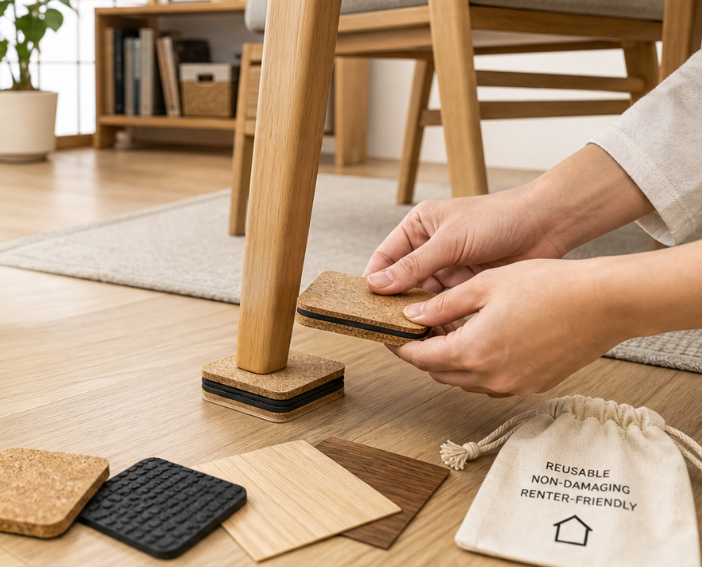
Stack the hard board and foam layer reasonably: the hard fiber board is placed at the bottom to bear weight, while the EVA foam is sandwiched in the middle for shock absorption. Fix each layer with transparent removable adhesive dots. The non-permanent adhesive allows users to separate and reorganize layers freely without material damage. This modular stacking method enables flexible height adjustment from two millimeters to one centimeter, adapting to various uneven floor conditions.
Step 4: Paste Felt Pad and Complete Finishing
Attach beige anti-slip felt pads on the top surface of the combined shim. The soft felt increases friction between the shim and furniture legs to prevent horizontal sliding. Place the finished shims under unstable furniture feet and gently shake the furniture to test balance. Fine-tune the number of foam layers until the structure remains completely stable. No drilling, paint modification, or permanent sticking is involved, fully complying with Japan’s move-out restoration rules.
Daily Usage and Functional Advantages
This handmade layered shim brings invisible long-term benefits to rental living. It effectively corrects furniture tilting and eliminates shaking and squeaking noises during usage. The increased bottom clearance allows robotic vacuums to pass smoothly, reducing hidden dust accumulation in dark dead corners. The multi-layer composite structure disperses heavy pressure, avoiding floor dents that lead to high compensation fees. During Japan’s humid tsuyu season, the raised gap accelerates air circulation, preventing moisture rot on wooden floorboards. When moving out, all shims can be disassembled, cleaned, and stored for repeated use in future apartments.
Broader Reflection: Coexisting with Architectural Imperfections
Most aging Japanese rental buildings inevitably retain structural flaws such as tilted floors and deformed wall surfaces. These irreversible architectural imperfections cannot be altered by ordinary tenants. This handmade shim represents a humble attitude toward flawed space: instead of pursuing perfect flatness, people actively build gentle balance. Tenants do not transform the building; they negotiate with uneven terrain through tiny auxiliary tools.
Moreover, the layered production process cultivates a meticulous spatial perception. Modern standardized furniture assumes ideal flat ground, while real old apartments are full of subtle height differences. Cutting boards, stacking layers, and adjusting thickness remind renters to observe hidden spatial irregularities. This trivial handmade behavior turns unstable flawed corners into stable, usable living areas.
Conclusion
The DIY reusable furniture lifting shim embodies modest accommodation wisdom in aging Japanese rental apartments. With cheap layered materials, simple stacking procedures, and traceless placement, it solves furniture shaking, floor denting, and cleaning dead-angle troubles. It protects building surfaces, stabilizes daily furniture, and lowers move-out inspection risks. In imperfect temporary living spaces, this tiny stacked gasket proves that spatial comfort does not require perfect architecture. Through subtle handmade balance, renters coexist gently with flawed floors, turning the imperfections of old apartments into stable, livable domestic environments.