Renter-Friendly DIY: Craft a Bendable Silicone Splash Guard for Compact Japanese Kitchens
Introduction
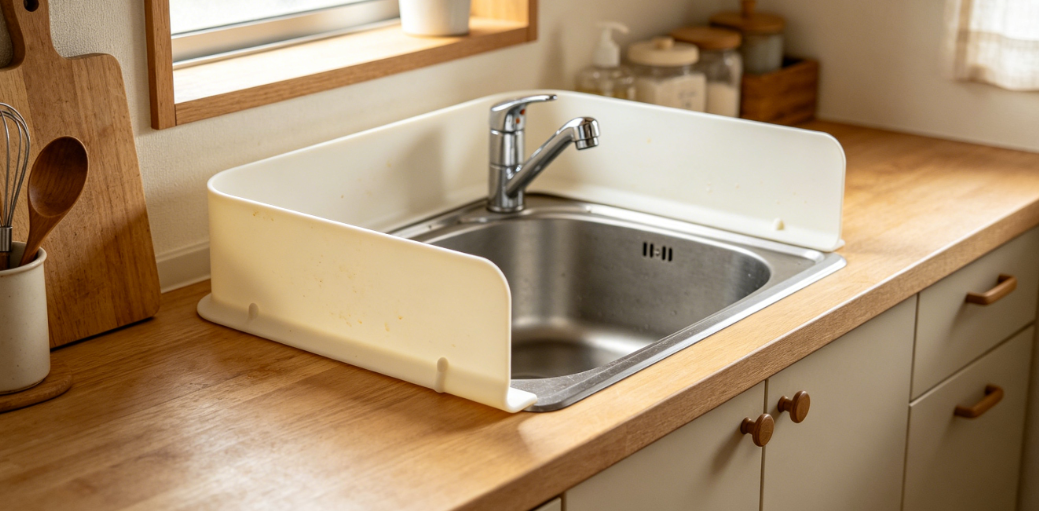
Most Japanese rental apartments feature ultra-compact kitchen spaces with narrow stainless steel sinks and minimal countertop area. During daily dishwashing and food preparation, splashing water and oil droplets continuously stain the surrounding walls, tile gaps, and wooden cabinet edges. Due to strict rental restoration clauses, tenants cannot install fixed metal splash panels, drill countertops, or apply permanent waterproof coatings. Over time, accumulated water stains breed black mold, leaving irreversible wall discoloration that results in heavy move-out deductions. Under such spatial and contractual constraints, a handmadebendable silicone splash guard becomes an economical and reversible solution. Constructed from soft waterproof materials from Japanese 100-yen stores, this flexible barrier blocks splashes, protects fragile kitchen walls, and simplifies daily cleaning. Beyond its waterproof function, this pliable handmade tool embodies the quintessential Japanese kitchen philosophy: maximizing limited counter space while maintaining invisible cleanliness.
Design Concept of the DIY Splash Guard
Unlike rigid commercial stainless steel baffles that occupy counter space, this handmade splash guard adopts an ultra-flexible curved structure tailored for cramped Japanese mini-kitchens. It adheres to three renter-oriented design principles: bendable adaptability, traceless fixation, and water-resistant durability. Many old Japanese apartments have uneven tiled corners; the soft silicone body naturally fits irregular wall angles without gaps. Furthermore, the matte waterproof surface resists oil adhesion and prevents mold growth in humid kitchen environments. Instead of stiffly separating water zones, this pliable barrier gently contains splashes, forming a soft buffer between wet operations and dry wall surfaces.
Required Materials (Available at Japanese 100-Yen Shops)
- Thick soft silicone rubber sheet (food-grade waterproof material)
- Clear removable acrylic adhesive strips
- Flexible waterproof edge sealing tape
- Small transparent suction cup fasteners
- Round-tip precision cutting scissors
Step-by-Step Fabrication Process
Step 1: Measure Sink Edge and Cut Silicone Sheet
Measure the side depth and back width of the rental stainless steel sink. Most Japanese compact sinks have sharp right-angle corners that easily accumulate stagnant water. Cut the silicone rubber sheet into an L-shaped baffle matching the sink’s geometric contour. Reserve a slight extension on the bottom edge to prevent water from seeping into tiny gaps between the countertop and the wall. Trim all corners into smooth arcs to eliminate sharp edges and avoid accidental cuts during kitchen operation.
Step 2: Reinforce Edges with Waterproof Tape
Wrap the raw cut edges of the silicone sheet with transparent waterproof sealing tape. This reinforcement prevents edge warping after long-term contact with water and oil. The seamless tape also eliminates tiny capillary gaps that absorb dirty water, effectively slowing mold propagation in humid kitchen environments. The clear tape maintains visual simplicity and does not disrupt the plain tone of standard Japanese kitchen interiors.
Step 3: Install Suction Cups and Adhesive Strips
Attach mini transparent suction cups on the inner side of the silicone baffle. These soft suction cups firmly cling to smooth stainless steel sink surfaces without leaving indentations. Paste removable acrylic adhesive strips on the upper wall-contacting edge. The low-residue adhesive gently fixes the baffle onto tiles and can be peeled off without damaging grout lines. The dual fixation system combines suction and mild adhesion to enhance overall stability during frequent water splashing.
Step 4: Bend and Shape for Fitted Installation
Manually bend the silicone sheet into a natural curved radian to fit the sink corner. Press the suction cups firmly and squeeze out internal air for stronger adsorption. Tear off the adhesive protective film and attach the upper edge to the wall. Shake the baffle lightly to test firmness; its flexible structure remains stable even under continuous water impact. The entire assembly requires no drilling, nails, or permanent modification, fully complying with Japanese rental regulations.
Daily Usage and Functional Advantages
This handmade splash guard greatly optimizes the hygiene condition of miniature rental kitchens. It intercepts flying water droplets and cooking oil stains, keeping wall tiles and wooden cabinets dry and clean. The non-stick silicone surface allows one-wipe cleaning, reducing daily maintenance time. During Japan’s humid rainy season, the sealed barrier prevents moisture from penetrating tile gaps and suppresses hidden mold growth. When not in use, the lightweight baffle can be effortlessly detached, folded flat, and stored in narrow kitchen drawers. Its reusable materials perfectly suit the transient lifestyle of young Japanese renters and foreign students.
Broader Reflection: Soft Adaptation in Restricted Living Spaces
Japanese rental kitchens are intentionally minimized to cut construction costs, leaving tenants with compressed operational space. Fixed sink structures and rigid wall tiles cannot adapt to personalized washing habits. This flexible silicone baffle represents a soft modification to inflexible architectural designs. Tenants do not rebuild kitchen facilities; instead, they create a pliable buffer to reconcile human operation with cramped spatial limitations.
Moreover, the simple handmade process cultivates subtle domestic awareness. In tiny kitchens, every water splash represents invisible spatial chaos. Cutting silicone, sealing edges, and installing suction cups encourage renters to pay attention to trivial domestic details. This gentle intervention transforms cold, functional kitchen corners into well-maintained personal cooking zones.
Conclusion
The DIY bendable silicone splash guard embodies minimalist kitchen wisdom for Japanese renters. With low-cost waterproof materials, easy shaping procedures, and residue-free installation, it solves splashing water, oil contamination, and mold accumulation in miniature kitchens. It protects rental walls, simplifies daily cleaning, and avoids unnecessary move-out penalties. Within spatially restricted temporary housing, this soft silicone barrier proves that livable kitchens do not depend on large-scale renovation. Through subtle handmade optimization, renters adapt to cramped layouts, maintain long-term sanitation, and build a neat, orderly cooking environment in borrowed homes.