Renter-Friendly DIY: Build Detachable Anti-Slip Dividers for Shallow Japanese Apartment Drawers
Introduction
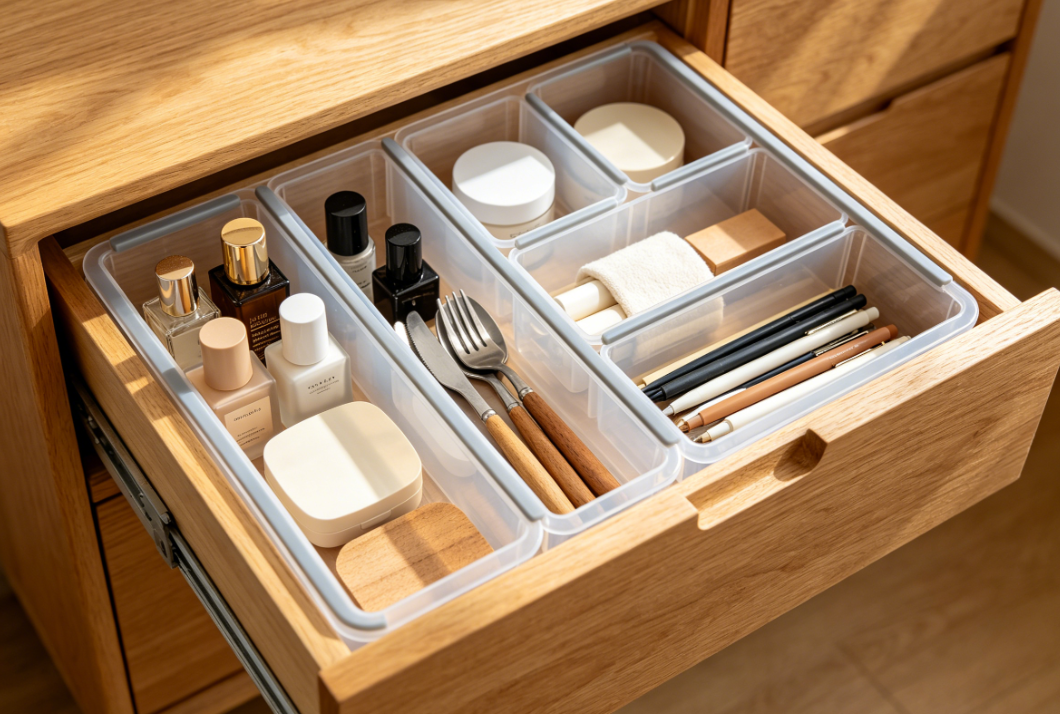
Most standard Japanese rental apartments are equipped with shallow, minimally designed storage drawers. These factory-made drawers rarely come with internal compartments, leaving flat empty spaces for daily belongings. During daily opening and closing, lightweight cosmetics, stationery, tableware, and small groceries slide chaotically inside due to abrupt inertia. Tenants are prohibited from installing fixed wooden partitions, embedding nails, or pasting permanent fixtures to alter drawer structures. Without effective separation, small items continuously collide, scatter, and accumulate clutter, wasting limited storage space. Under such rental restrictions, a handmade detachable anti-slip drawer divider becomes an economical and reversible solution. Constructed from lightweight plastic boards and silicone anti-slip strips, this simple tool splits messy drawers into independent storage zones. Beyond organizational functionality, this delicate handmade accessory reflects the intrinsic Japanese storage philosophy: refining trivial space to achieve orderly minimalism.
Design Concept of the DIY Divider
Unlike rigid fixed wooden baffles that damage drawer interiors, this handmade divider adopts a spliced modular structure tailored for shallow Japanese storage cabinets. It follows three renter-oriented design principles: friction-based fixation, flexible combination, and zero-surface damage. Most rental drawers feature smooth plastic or wooden inner walls that lack natural friction; therefore, soft silicone strips are added to enhance stability without adhesive residue. Instead of completely isolating spaces with solid boards, this assembled system creates adjustable compartments to adapt to changing daily items. Its translucent neutral tone maintains the plain, neat aesthetic of typical Japanese storage spaces.
Required Materials (Available at Japanese 100-Yen Shops)
- Semi-transparent rigid plastic partition sheets
- Soft matte silicone anti-slip strips
- Mini plastic cross-buckles for splicing
- Removable transparent friction pads
- Round-edge precision cutting scissors
Step-by-Step Fabrication Process
Step 1: Measure Drawer Depth and Cut Plastic Panels
Measure the internal length, width and height of the rental drawer. Japanese apartment drawers are usually shallow with low side baffles, making tall dividers unnecessary. Cut the rigid plastic sheets into flat rectangular panels according to internal dimensions, reserving a 5-millimeter margin for easy insertion and removal. Smooth all cut edges to prevent scratching the drawer’s inner coating. The translucent plastic material is chosen for its lightweight texture, waterproof property, and invisible visual effect inside closed cabinets.
Step 2: Attach Silicone Anti-Slip Strips
Paste thin silicone anti-slip strips along the bottom and side edges of each plastic panel. These elastic strips increase friction between dividers and smooth drawer walls, preventing sliding and shaking during frequent pulling movements. The soft silicone also acts as a buffer to eliminate collision noise when drawers are closed hastily. Unlike strong glue, the silicone strips are physically attached and can be peeled off without leaving sticky traces.
Step 3: Assemble Cross Splicing Structure
Cut tiny connecting notches on the middle of each plastic board. Interlock vertical and horizontal panels through reserved gaps and fasten the joints with mini plastic cross-buckles. This cross assembly method creates flexible grid compartments. Tenants can increase or decrease the number of panels to change grid sizes, adapting to tall bottles, flat cosmetics, slender stationery, and irregular daily fragments. The assembled structure remains lightweight without deforming under daily pressure.
Step 4: Insert and Test Overall Stability
Place the finished splicing divider into the empty drawer. Paste transparent friction pads on the outer contact points to fill subtle wall gaps. Swiftly open and close the drawer repeatedly to test anti-slip performance. If slight shaking occurs, adjust the silicone angle to enhance clinging force. The entire installation requires no drilling, chemical glue, or permanent modification, fully complying with Japan’s strict restoration regulations upon moving out.
Daily Usage and Functional Advantages
This handmade drawer divider optimizes internal storage logic for compact rental furniture. It classifies scattered small objects into independent grids, avoiding chaotic collision and entanglement inside shallow drawers. The waterproof plastic surface resists dust and oil stains, allowing direct wiping during daily cleaning. During Japan’s humid rainy season, the hollow splicing structure retains air permeability, suppressing mildew growth on stationary tableware and fabric accessories. When tenants need to reorganize storage layouts, the dividers can be disassembled, rearranged, or completely removed within seconds. All components are reusable and easy to store in folded flat form.
Broader Reflection: Order within Restricted Miniature Spaces
Japanese rental furniture is mass-produced with universal single-space designs, ignoring personalized sorting needs. Fixed empty drawers force residents to adapt to standardized storage logic. This handmade spliced divider represents a gentle reconstruction of private miniature space. Tenants do not alter furniture structures; instead, they insert invisible auxiliary layers to reshape internal spatial order.
Furthermore, the simple assembly process cultivates sorting awareness. In fast-paced urban life, trivial scattered items often cause invisible mental pressure. Cutting panels, interlocking grids, and adjusting friction strips encourage renters to observe tiny storage corners. This trivial handmade ritual transforms blank indifferent drawers into structured, controllable personal storage territories.
Conclusion
The DIY detachable drawer divider embodies minimalist storage wisdom for Japanese renters. With low-cost plastic accessories, intuitive splicing procedures, and traceless placement, it solves item sliding, messy accumulation, and single-functional drawer limitations. It maintains the original furniture integrity, improves storage efficiency, and reduces daily tidying time. In standardized temporary living spaces, this lightweight grid system proves that neatness does not rely on expensive customized cabinets. Through subtle handmade intervention, renters reorganize trivial belongings, maintain domestic order, and pursue quiet minimalist comfort within constrained rental furniture.