Renter-Friendly DIY: Craft a Reusable Dehumidifying Drawer Liner for Humid Japanese Apartments
Introduction
Japan’s humid subtropical climate brings persistent dampness throughout spring and the rainy tsuyu season. Most standard rental apartments are equipped with unvarnished wooden closets and sealed drawers that lack internal ventilation. These enclosed storage spaces easily accumulate condensed moisture, leading to mold spots, musty odors, and tiny dust mites. Since tenants cannot renovate cabinet structures or install permanent ventilation devices, improving internal storage conditions becomes extremely challenging. Under such limitations, a handmadebreathable dehumidifying drawer liner serves as a subtle and effective solution. Made of low-cost 100-yen shop materials, this customizable liner absorbs excess moisture, filters fine dust, and maintains air circulation inside closed cabinets. Beyond its practical dehumidification function, this simple handmade item embodies the quiet Japanese living philosophy of coexisting with natural humidity rather than completely resisting it.
Design Logic of the DIY Drawer Liner
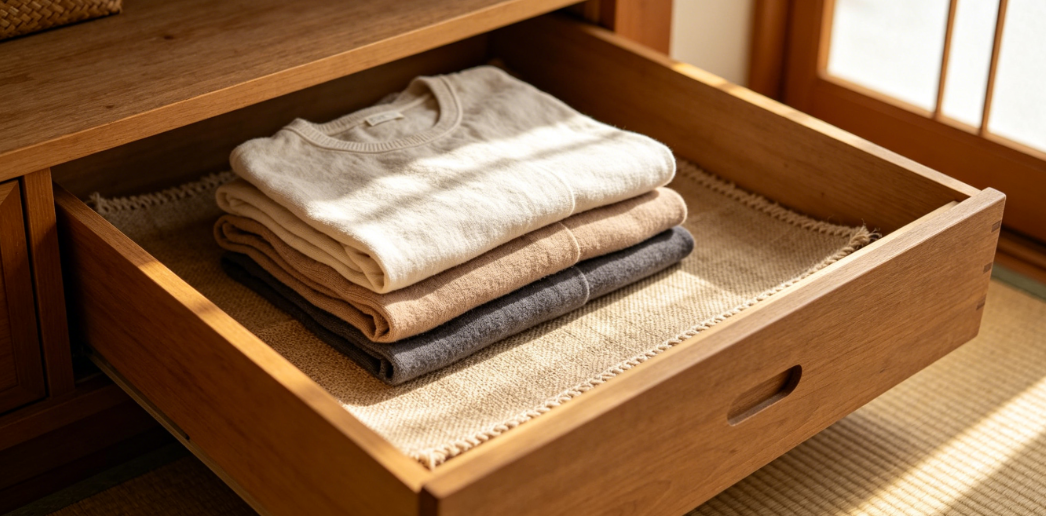
Unlike thick plastic commercial liners that trap moisture, this handmade dehumidifying pad adopts a three-layer breathable structure specifically designed for damp Japanese households. It follows three renter-oriented principles: reversible laying, natural moisture absorption, and dust isolation. The surface layer allows airflow, the middle layer stores dampness, and the bottom layer prevents moisture backflow from cold wooden boards. Additionally, all materials are cuttable and reusable, perfectly matching the irregular sizes of old rental drawers. Instead of forcibly drying the air with electricity, this liner gently balances micro humidity through physical adsorption, reflecting Japan’s restrained wellness lifestyle.
Required Materials (Available at Japanese 100-Yen Stores)
- Thick non-woven breathable fabric (one large sheet)
- Natural bamboo charcoal dehumidifying particles
- Ultra-thin mesh isolation net
- Flexible edge-sealing adhesive tape (fabric type)
- Silicone anti-slip tiny dots
Step-by-Step Fabrication Process
Step 1: Measure and Cut the Fabric Layers
Use a soft measuring tape to record the inner length and width of the rental drawers. Many old Japanese cabinets have uneven bottoms and tilted edges, requiring manually customized dimensions. Cut the non-woven fabric and mesh net into identical rectangular pieces slightly smaller than the drawer base. Leave one centimeter of extra margin on each side for later edge sealing. The soft fabric is intentionally chosen to avoid scratching unprotected wooden cabinet surfaces, preventing compensation risks during move-out inspections.
Step 2: Make Partition Compartments for Charcoal Particles
Lay the non-woven fabric flat and paste thin fabric adhesive strips to divide the fabric into four to six independent small compartments. These evenly spaced partitions prevent bamboo charcoal particles from accumulating in one corner. Even distribution ensures uniform moisture absorption across the entire drawer. This partitioned structure avoids localized dampness, which commonly occurs in simple single-layer dehumidification pads.
Step 3: Fill and Seal Bamboo Charcoal Particles
Pour dry bamboo charcoal particles into each separated compartment. Control the filling volume at fifty percent capacity to keep the fabric soft and foldable. Cover the top with mesh isolation net and press the edges tightly. Seal the four sides with fabric adhesive tape to prevent charcoal powder leakage. The transparent mesh layer retains internal ventilation while blocking fine dust, achieving a balanced state between air permeability and purification.
Step 4: Attach Anti-Slip Silicone Dots
Stick miniature silicone anti-slip dots evenly on the bottom of the finished liner. These soft friction points prevent the pad from shifting when pulling drawers open and closed. Slightly squeeze the completed liner to expel trapped air and test its flexibility. The whole production process uses no liquid glue or chemical additives, ensuring an odorless and harmless storage environment for clothes and daily necessities.
Daily Usage and Practical Advantages
This handmade drawer liner brings long-term invisible protection to rental storage spaces. It absorbs condensed water vapor inside closed drawers, effectively suppressing mold growth and musty fabric odor. The breathable structure avoids heat and moisture accumulation, keeping cotton clothes, towels, and undergarments dry throughout the rainy season. When the liner becomes damp after one month, tenants can simply place it on balconies to sun-dry and restore its adsorption capacity. Furthermore, the soft surface reduces friction between hard wood and clothing, protecting delicate fabrics from wear. No installation drilling or permanent fixation is needed, making it fully compliant with Japanese rental restoration rules.
Broader Reflection: Humility in Humid Living Spaces
Japan’s high humidity is an unavoidable natural condition for urban renters. Instead of relying on power-consuming dehumidifiers, local residents prefer mild, low-energy handmade tools. This simple charcoal liner represents the Japanese attitude toward nature: accepting humidity rather than eliminating it brutally. Every breathable layer and every charcoal particle forms a gentle negotiation between human belongings and damp architecture.
Moreover, making such daily maintenance tools cultivates subtle living awareness. In standardized rental rooms, people easily become indifferent to hidden dampness, dust, and tiny bacteria. Cutting fabrics, sealing edges, and filling charcoal remind renters to observe microscopic changes in their living environment. This slight sense of care turns a cold borrowed cabinet into a stable, clean personal storage zone.
Conclusion
The reusable DIY dehumidifying drawer liner is an understated but essential rental gadget in Japan. With cheap natural materials, simple manual stitching and sealing procedures, and reversible placement, it solves hidden moisture problems in aging wooden cabinets. It protects personal belongings, purifies stagnant air, and adapts to Japan’s humid seasonal changes. In limited temporary living spaces, this soft handmade liner proves that comfortable rental living does not depend on expensive electrical equipment. Instead, quiet, tiny modifications help people live gently and harmoniously with the unique climatic and architectural characteristics of Japanese apartments.