Simple Investing Strategies for Long-Term Wealth: A Guide for Everyone

Investing is often viewed as a complex process reserved for financial experts, but it doesn’t have to be. In fact, the most successful investing strategies are often the simplest ones—focused on consistency, patience, and alignment with your personal goals. Whether you’re a student just starting to save, a young professional building your career, or someone planning for retirement, investing is a powerful way to grow your money over time and achieve financial security. This article breaks down the basics of investing in plain language, offering actionable steps to help you get started and stay on track.
Why Investing Beats Saving Alone
Saving money is important for short-term needs and emergencies, but it’s not enough to build long-term wealth. Traditional savings accounts offer very low interest rates, which means your money grows slowly—often not even keeping up with inflation. Inflation is the gradual increase in the cost of goods and services, and it erodes the purchasing power of your cash over time. For example, if inflation is 2% per year, $100 today will only be worth about $78 in 15 years.
Investing, on the other hand, allows your money to grow at a faster rate. By putting your money into assets like stocks, bonds, or funds, you have the potential to earn higher returns that outpace inflation. The key driver of long-term growth is compound interest—earning interest on both your initial investment and the interest you’ve already earned. Over decades, this compounding effect can turn small, regular investments into a significant nest egg.
Getting Started: What You Need to Know First
1. Define Your Goals
Before you start investing, take a moment to think about your financial goals. What are you investing for? Is it retirement, a down payment on a house, a child’s education, or something else? Your goals will determine how much you need to invest, how long you can invest for, and how much risk you can take.
For example, if you want to retire in 30 years, you have a long time horizon and can afford to take on more risk (since market downturns will have time to recover). If you’re saving for a down payment in 5 years, you’ll want to choose lower-risk investments to protect your money.
2. Understand Risk Tolerance
Risk tolerance is how comfortable you are with the possibility that your investments could lose value in the short term. All investments carry some risk, but the level of risk varies by asset type. Stocks, for example, are more volatile than bonds—their value can go up and down quickly—but they also offer higher long-term returns.
If you’re someone who gets anxious when the market drops, you have a low risk tolerance and should focus on more conservative investments like bonds or high-yield savings accounts. If you can handle short-term fluctuations for long-term gains, you have a higher risk tolerance and can invest more in stocks or equity funds.
3. Choose the Right Investments
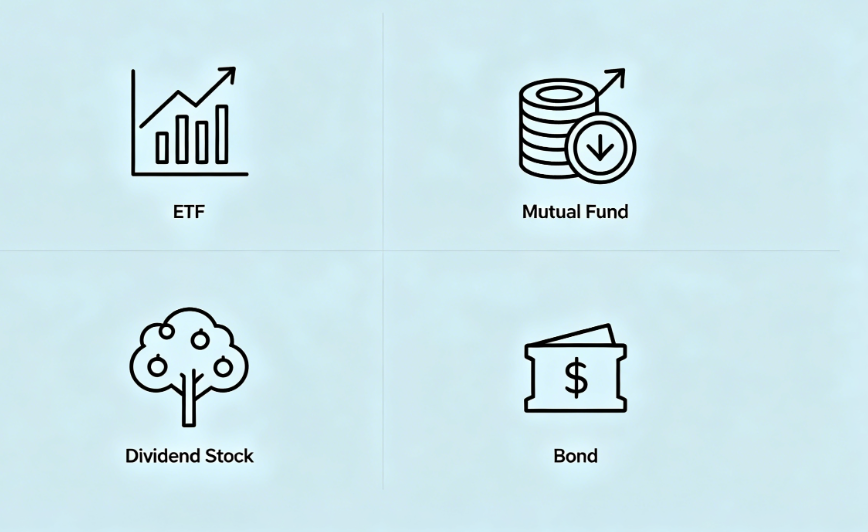
There are many investment options available, but beginners should start with simple, low-cost choices that are easy to understand. Here are the most common options for new investors:
- Index ETFs: Exchange-Traded Funds (ETFs) that track a market index, like the S&P 500. They offer instant diversification (exposure to hundreds of stocks) with low fees, making them ideal for beginners. You can buy and sell ETFs on stock exchanges just like individual stocks.
- Mutual Funds: Similar to ETFs, mutual funds pool money from multiple investors to invest in a diversified portfolio. They are managed by professionals, but they often have higher fees than ETFs. Mutual funds are a good choice if you prefer a hands-off approach.
- Dividend Stocks: Stocks of companies that pay regular dividends (a portion of their profits) to shareholders. Dividend stocks provide a steady income stream and can be less volatile than growth stocks.
- Bonds: Loans to governments or corporations that pay a fixed interest rate over time. Bonds are low-risk and provide a steady return, making them a good addition to a balanced portfolio.
Proven Strategies for Investment Success
1. Invest Consistently
One of the biggest mistakes new investors make is trying to “time the market”—buying low and selling high based on short-term trends. This is nearly impossible to do consistently, even for experts. Instead, use dollar-cost averaging (DCA): invest a fixed amount of money at regular intervals (e.g., monthly) regardless of market conditions.
DCA works because it reduces the impact of market volatility. When prices are low, you buy more shares; when prices are high, you buy fewer shares. Over time, this averages out your cost per share and helps you build wealth steadily.
2. Diversify Your Portfolio
Diversification is the practice of spreading your investments across different asset classes, industries, and geographic regions. This reduces the risk of losing money if one investment or sector performs poorly. For example, if the technology sector declines, your investments in healthcare or consumer goods may offset those losses.
For beginners, diversification is easy to achieve with index ETFs or mutual funds, which already hold a variety of assets. You don’t need to pick individual stocks to build a diversified portfolio—simple, broad-market funds are enough to get started.
3. Keep Costs Low
Fees can eat into your investment returns over time, so it’s important to choose low-cost options. Look for ETFs and mutual funds with low expense ratios (the annual fee charged by the fund). Avoid frequent trading, as each transaction can incur fees and trigger capital gains taxes. The less you pay in fees, the more of your returns stay in your pocket.
4. Stay the Course
Investing is a long-term journey, and market downturns are inevitable. The most successful investors are those who stay disciplined and avoid making emotional decisions. When the market drops, resist the urge to sell—history has shown that markets tend to recover over time. Instead, focus on your long-term goals and trust your strategy.
Final Thoughts
Investing doesn’t have to be complicated. By defining your goals, understanding your risk tolerance, choosing simple, low-cost investments, and investing consistently, you can build long-term wealth and achieve financial security. Remember, the best time to start investing is today—even small, regular investments can grow significantly over time thanks to compound interest.
You don’t need to be a financial expert to be a successful investor. All you need is patience, discipline, and a willingness to learn. Start small, stay consistent, and let time do the work for you. Your future self will thank you.