Renter-Friendly DIY: Craft Breathable Anti-Mildew Support Strips for Compact Rental Closets
Introduction
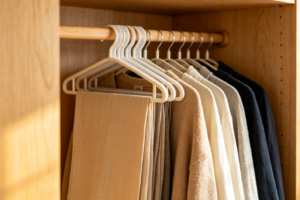
The majority of Japanese rental apartments are equipped with narrow enclosed closets with poorly ventilated wooden panels. During Japan’s prolonged rainy tsuyu season and humid early summer, stagnant air inside dark cabinets easily accumulates moisture, causing clothing mildew, musty odors, and stubborn dark mold spots on fabric. Moreover, standard thin metal hangers squeeze garment shoulders tightly, leaving permanent sharp creases on coats and shirts. Tenants are prohibited from installing fixed ventilation fans, punching additional hanging rods, or pasting permanent adhesive on closet inner walls. Commercial widened hangers are costly and bulky for slim Japanese cabinet dimensions. To improve air circulation and eliminate clothing indentations without altering closet structures, renters can fabricate a handmade breathable anti-mildew clothes support strip. Constructed from curved hollow plastic tubes and moisture-absorbing non-woven fabric, this lightweight accessory broadens bearing areas and retains flowing air gaps between crowded garments. Beyond fabric protection and dehumidification, this delicate handmade tool interprets quiet Japanese storage philosophy: maintaining textile freshness through gentle airflow rather than mechanical modification.
Design Concept of the DIY Support Strip
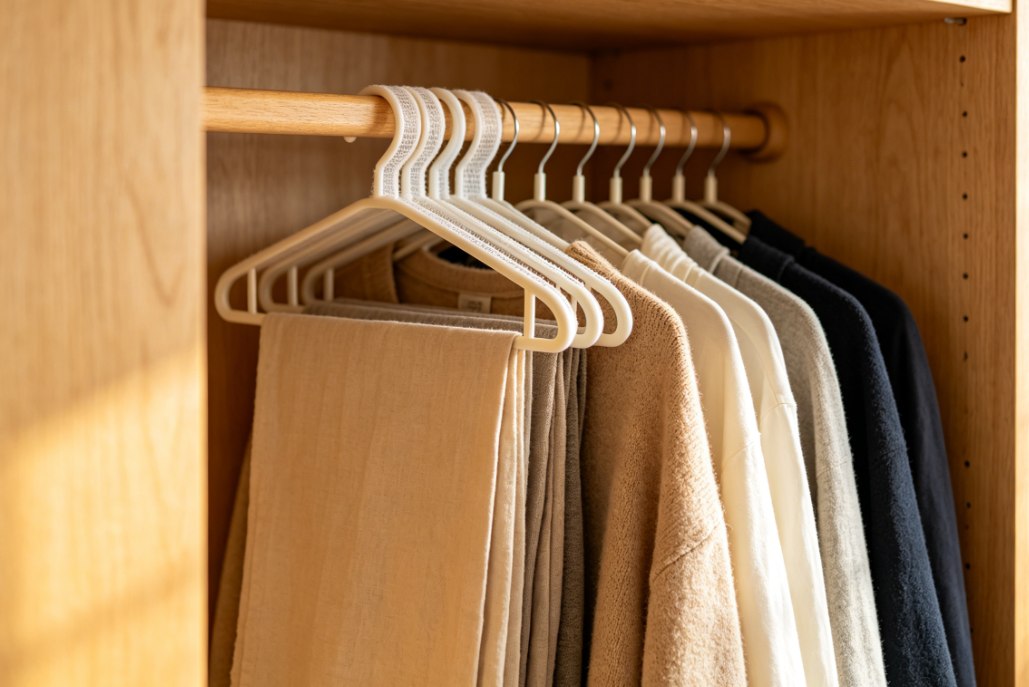
Unlike solid thick commercial shoulder hangers that block air passage, this handmade support strip adopts a hollow tubular breathable structure customized for narrow Japanese closets. It follows three renter-oriented design principles: curved pressure dispersion, hollow airflow circulation, and traceless reversible installation. Most rental closets feature low hanging rods and cramped internal spacing, leaving almost no gap between dense hanging clothes. This arched strip smoothly disperses shoulder pressure while reserving tiny breathable channels. Instead of isolating garments with sealed materials, it guides humid air to circulate naturally inside the cabinet. Its milky translucent tone blends seamlessly into dim closet interiors without creating visual clutter.
Required Materials (Available at Japanese 100-Yen Shops)
- Flexible hollow PE plastic tubular strips
- Moisture-absorbing non-woven fabric sheet
- Mini silicone anti-slip locking rings
- Thin elastic binding cord
- Round-head burr-free cutting scissors
Step-by-Step Fabrication Process
Step 1: Cut Tubular Strips into Arched Contours
Measure the shoulder width of commonly worn jackets, shirts, and knitwear. Most daily garments require a gentle curved supporting radian to avoid sharp folding lines. Cut the hollow plastic tube into symmetrical arched strips with smooth radian. The hollow tube structure reduces overall weight and reserves internal air flow channels. Trim both ends into rounded smooth mouths to prevent fabric snags and thread pulling. The soft bendable plastic maintains stable curvature without deformation under long-term clothing pressure.
Step 2: Wrap with Moisture-Absorbing Fabric
Cover the outer curved surface of the plastic arch with breathable non-woven fabric. This porous textile continuously absorbs tiny water molecules lingering inside the damp closet. The soft fabric layer eliminates hard friction between cold plastic and delicate clothing fabrics, protecting wool, cotton, and linen materials from abrasion. In fluctuating humid temperatures, the breathable weave accelerates surface evaporation and prevents condensed water from adhering to garment shoulders.
Step 3: Fix Silicone Anti-Slip Locking Rings
Install miniature silicone rings at both ends of the arched strip. These elastic loops firmly clamp ordinary metal hangers and prevent lateral sliding. Crowded hanging clothes often squeeze each other and shift sideways; the locking structure fixes each support strip at a stable position. The insulating silicone also isolates cold metal temperature, reducing moisture condensation caused by temperature difference between hangers and fabrics.
Step 4: Bind and Test Bearing Stability
Reinforce the connection between tubes and fabric with thin elastic cords to prevent loosening after long-term suspension. Hang the finished strip on standard closet rods and drape different types of clothing over the curved surface. Shake gently to test anti-slip performance and structural stability. No drilling, gluing, or wall modification is involved. All components can be disassembled and cleaned repeatedly, fully complying with Japanese rental restoration clauses.
Daily Usage and Functional Advantages
This handmade clothes support strip greatly improves the microenvironment inside damp rental closets. The widened curved surface eliminates sharp hanger indentations and preserves garment shoulder lines. Hollow tubular channels promote air convection between densely arranged clothes, significantly reducing mildew growth and musty odor. The moisture-absorbing fabric passively regulates local humidity, adapting to Japan’s rapidly changing seasonal dampness. During dry winter months, the porous structure prevents static accumulation and fabric adhesion. All lightweight strips can be stacked flat for storage during relocation, saving luggage space.
Broader Reflection: Constructing Invisible Breathing Spaces
Standard rental closets are designed for storage capacity rather than air circulation. Closed dark cabinets trap humid air, treating clothing as static stored objects instead of breathable textiles. This handmade arched strip represents a soft reconstruction of cramped storage space. Tenants do not refit closet frames or install ventilation equipment; instead, they create tiny artificial gaps to awaken passive air flow.
Furthermore, the wrapping and binding process cultivates subtle sensitivity to humidity. People often notice visible mold stains while ignoring invisible moist air stagnation inside cabinets. Cutting curved tubes, wrapping absorbent fabric, and installing locking rings remind renters to observe hidden dampness in marginal living spaces. This trivial handmade behavior transforms airtight crowded cabinets into gently circulating storage zones.
Conclusion
The DIY breathable anti-mildew clothes support strip embodies meticulous textile protection wisdom for Japanese renters. With hollow tubular structures, moisture-absorbing textiles, and traceless suspension design, it solves clothing creases, mildew contamination, and air stagnation troubles. It protects personal garments, improves closet air quality, and adapts to Japan’s humid climate. In airtight standardized temporary cabinets, this slim arched strip proves that domestic preservation does not require expensive dehumidification machines. Through subtle handmade shaping, renters build invisible breathing gaps, balance indoor humidity, and maintain fresh, tidy, and well-preserved clothing storage in borrowed Japanese residences.