Renter-Friendly DIY: Craft Adjustable Hidden Cable Holders for Messy Rental Desks
Introduction
Most Japanese rental rooms are equipped with compact minimalist desks with smooth hard surfaces. Fixed socket positions are often far from desktop working areas, forcing tenants to extend charging cables, data wires and adapter lines across the tabletop. These slippery cables constantly slide off smooth desks, hang loosely in the air, and tangle together, creating visual chaos and usage inconvenience. Tenants are prohibited from drilling holes or using permanent strong adhesive, which leaves stubborn residual marks on desk surfaces and leads to move-out deductions. Commercial cable organizers are usually fixed in size, bulky and incompatible with slim Japanese-style desks. To solve scattered desktop wiring without damaging rental furniture, renters can create an adjustable hidden cable holder. Made of bendable plastic sheets and soft silicone clips, this miniature handmade fixture fixes various cables stably and hides redundant wiring. Beyond simple tidying functions, this delicate tool reflects subtle Japanese living philosophy: organizing trivial daily details to maintain a clean and restrained domestic visual order.
Design Concept of the DIY Cable Holder
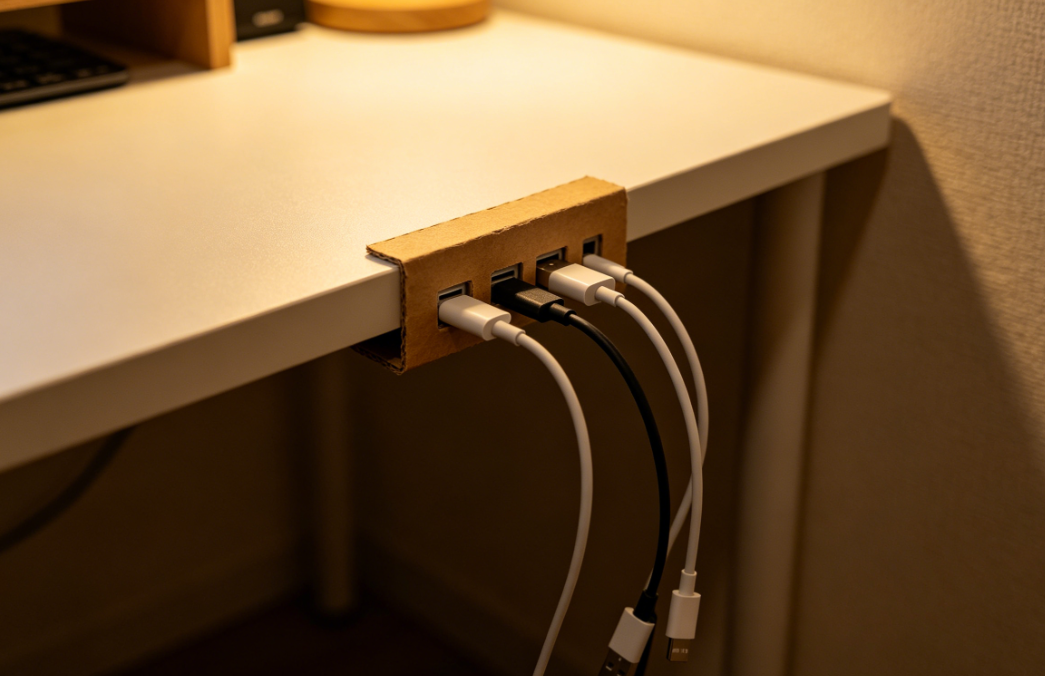
Unlike rigid one-piece commercial cable clamps that cannot change size, this handmade holder adopts a flexible spliced structure tailored for narrow Japanese desktops. It follows three renter-oriented design principles: adjustable clamping width, traceless physical fixation, and hidden installation. Rental desks feature smooth waterproof coatings that make ordinary stickers easy to peel off and leave stains. This tool abandons permanent glue and uses physical extrusion for fixation. Instead of exposing cables externally, it hides redundant wire segments under the desk, retaining a neat empty desktop for daily study and work. Its transparent low-profile design fits all plain-toned rental furniture without breaking minimalist interior aesthetics.
Required Materials (Available at Japanese 100-Yen Shops)
- Flexible transparent PVC plastic thin sheet
- Soft non-slip silicone clamping strips
- Removable invisible rubber suction pads
- Thin elastic binding loops for redundant wires
- Round-head safe precision cutting scissors
Step-by-Step Fabrication Process
Step 1: Cut Plastic Sheet into Curved Clamp Template
Observe the thickness of commonly used cables, including charging wires, earphone lines and adapter cables. Cut the transparent PVC sheet into small curved strips. Each strip is shaped into a gentle arc to wrap cables without squeezing and damaging the internal wire core. Reserve different opening sizes to adapt to thick power cords and thin data lines. Trim all cutting edges into smooth round corners to avoid scratching desk coatings and insulated cable surfaces. The bendable PVC material possesses good toughness and will not crack after repeated bending.
Step 2: Paste Silicone Anti-Slip Inner Strips
Attach matte silicone strips to the inner curved surface of the plastic clamp. The high-friction silicone increases gripping force to prevent smooth cables from slipping out accidentally. The soft material also buffers rigid contact between plastic and wires, avoiding long-term extrusion deformation of cable insulation layers. In dry Japanese winters, the insulating silicone effectively reduces static electricity adsorption, decreasing dust accumulation on the cable surface.
Step 3: Install Suction Pads for Traceless Fixation
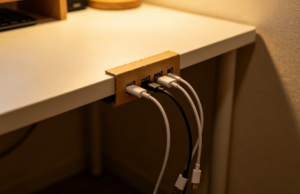
Stick tiny invisible rubber suction pads on the outer back of the plastic clamp. Instead of chemical glue, physical adsorption is used to fix the holder on the side or bottom of the desktop. Suction pads can be easily peeled off without leaving any sticky residue or faint indentation on the rental desk. Users can freely move the holder to different positions according to daily usage habits, realizing flexible spatial adaptation.
Step 4: Equip Binding Loops and Test Stability
Install elastic binding loops on the tail of each clamp to store excess cable length. Wind redundant wires neatly and fix them with loops to prevent hanging clutter. Insert various cables into the curved clamp and shake gently to test anti-slip performance. Adjust the bending radian of the plastic strip to change clamping tightness. The entire production process requires no toxic materials or destructive operations, fully complying with Japanese rental furniture protection regulations.
Daily Usage and Functional Advantages
This handmade cable holder thoroughly optimizes desktop wiring environment in compact rental rooms. It fixes frequently used cables at the edge of the desk, preventing sudden slipping and messy suspension. Redundant wires are hidden under the table to save visible desktop space, creating a clean working area. The insulating silicone material protects cables from abrasion and prolongs service life. During Japan’s humid rainy season, the suspended hidden structure avoids direct contact between wires and damp table surfaces, reducing leakage risks. When moving out, all components can be disassembled, cleaned and stored for repeated use.
Broader Reflection: Reconstructing Minimal Daily Order
Standard rental desks are mass-produced with single flat structures, lacking customized reserved positions for electronic cables. Disordered wires are often ignored as trivial details, gradually disrupting indoor visual balance and causing subtle mental distraction. This miniature handmade clamp represents a gentle correction to indifferent industrial furniture. Tenants do not modify desk structures; instead, they add tiny auxiliary fixtures to discipline scattered electronic lines.
Furthermore, the simple cutting and pasting process cultivates refined living awareness. People tend to pursue a tidy desktop while overlooking hidden wiring chaos under the table. Shaping curved plastic, attaching silicone strips, and fixing suction pads encourage renters to observe overlooked marginal spaces. This trivial handmade behavior reorganizes scattered electronic wires and builds a stable minimalist daily workspace.
Conclusion
The DIY adjustable hidden cable holder embodies delicate tidying wisdom for Japanese renters. With flexible bendable materials, physical traceless fixation, and adjustable clamping structure, it solves cable slipping, desktop clutter and redundant wiring confusion. It protects original rental furniture, optimizes working space, and simplifies daily wire management. In standardized compact temporary apartments, this tiny transparent clamp proves that domestic neatness does not rely on expensive storage accessories. Through subtle handmade modification, renters constrain messy cables, eliminate visual distractions, and construct simple, orderly and efficient private working corners in borrowed Japanese residences.