Renter-Friendly DIY: Craft Reusable Buffer Guards to Protect Fragile Rental Walls
Introduction
Most Japanese rental accommodations are constructed with thin gypsum walls and delicate painted plaster surfaces. Tenants commonly place beds, cabinets, and air conditioners against interior walls to save limited floor space. Due to subtle walking vibration, wind airflow, and compressor operation, furniture gently shifts and repeatedly collides with bare walls. Continuous friction creates peeling paint, gray scuff marks, and uneven dents—damage that leads to heavy deduction fees during move-out inspections. Strict rental regulations prohibit drilling nails, installing permanent brackets, or applying strong adhesive to wall surfaces. Commercially sold wall protectors are often oversized, rigid, and aesthetically inconsistent with minimal Japanese interiors. Under such constraints, renters can create a handmade layered furniture buffer wall guard. Made of soft felt fabric and resilient silicone spacers, this tiny reversible tool fills narrow gaps between furniture and walls, absorbing subtle shaking and preventing surface abrasion. Beyond physical protection, this handmade accessory embodies quiet Japanese residential thinking: preserving architectural integrity through gentle, non-destructive intervention.
Design Concept of the DIY Wall Guard
Unlike thick hard plastic bumpers that create awkward visible gaps, this wall guard adopts a slim multi-layered structure tailored for narrow Japanese room layouts. It follows three renter-oriented design principles: vibration absorption, traceless contact, and invisible integration. Gypsum walls in low-cost Japanese apartments lack hardness and are easily scratched by sharp furniture edges. This soft buffer utilizes compressible materials to disperse local pressure. Instead of rigidly fixing heavy furniture, it provides elastic tolerance for minor daily movement. Its neutral muted tone seamlessly blends into plain white walls, maintaining the uncluttered visual language of minimalist Japanese living spaces.
Required Materials (Available at Japanese 100-Yen Shops)
- Soft thick wool felt sheet (shock-absorbing textile layer)
- Transparent elastic silicone spacer pads
- Removable water-based nano adhesive dots
- Thin matte protection film
- Round-head safe precision scissors
Step-by-Step Fabrication Process
Step 1: Measure Furniture Edges and Cut Felt Sheet
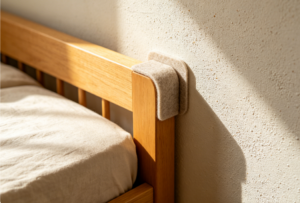
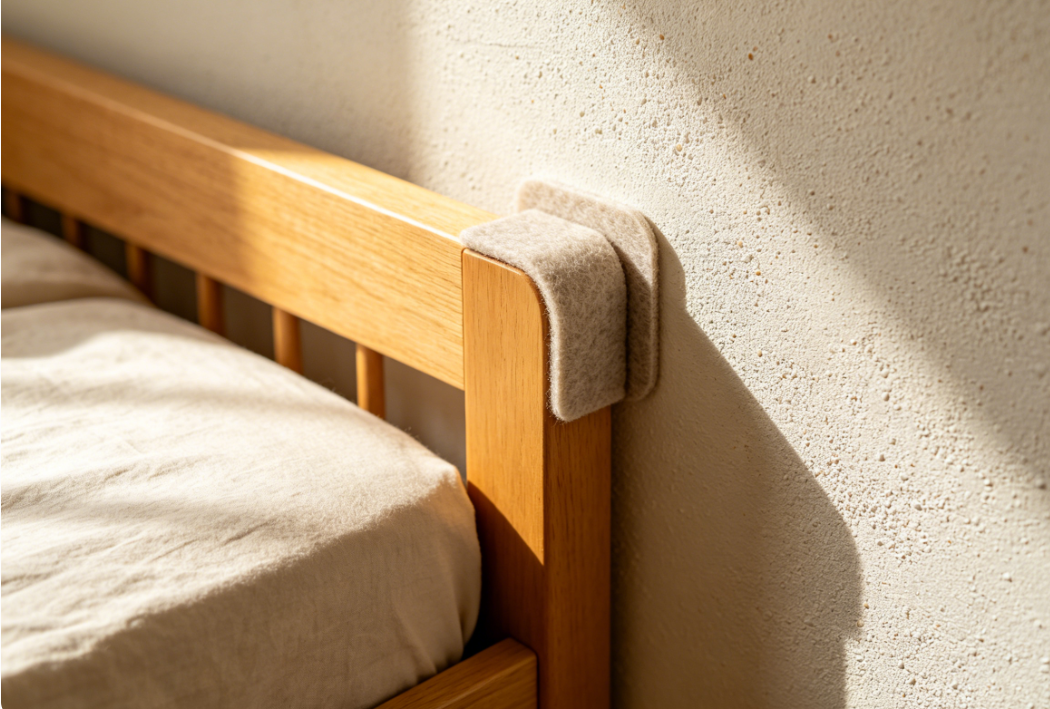
Examine the contact points between furniture and walls. Common pressure points include bed corners, cabinet backs, and metal air conditioner frames. Cut the wool felt sheet into small rounded square pieces. Rounded corners eliminate sharp edges that may tear thin wall paint. The soft fibrous texture of felt is chosen for its excellent noise-dampening ability and low friction surface. Each piece is intentionally kept compact to avoid protruding and affecting indoor aesthetics.
Step 2: Attach Silicone Spacers for Elastic Support
Stick transparent silicone spacers onto the back of the felt piece. These elastic raised pads create a tiny breathable gap between felt and wall. The hollow buffer space absorbs subtle vibration generated by air conditioners or body movement on beds. Unlike flat single-layer pads, this composite structure balances soft cushioning and stable supporting force, preventing furniture from tilting or slipping.
Step 3: Cover Surface with Matte Protection Film
Wrap the outer felt layer with thin matte transparent film. This isolating film prevents fabric fibers from dropping and avoids direct static contact with dusty walls. In humid Japanese seasons, it resists moisture penetration and prevents mildew formation inside the felt layer. The matte coating eliminates artificial glare, ensuring the buffer remains visually concealed under dim indoor lighting.
Step 4: Install and Test Buffering Effect
Apply removable nano adhesive dots on the rearmost silicone layer. Attach the finished buffer pad to furniture edges instead of directly onto walls. This clever installation method ensures zero wall residue after removal. Gently shake the furniture to test friction and stability. Adjust pad quantity at stress concentration points to eliminate shaking sounds. The entire assembly requires no drilling, permanent glue, or structural modification, fully complying with Japanese rental restoration standards.
Daily Usage and Functional Advantages
This handmade wall buffer effectively prevents wall abrasion and paint peeling in compact rental rooms. It eliminates dull collision noise caused by nightly furniture shifting, creating a quieter sleeping environment. The invisible slim design does not occupy extra indoor space or disrupt minimalist decoration. During Japan’s humid rainy season, the reserved air gap accelerates backflow air circulation, avoiding moldy dark spots between furniture and walls. When relocating, all pads can be peeled off, cleaned, and stored for repeated use. The low-cost materials greatly reduce unnecessary rental compensation risks.
Broader Reflection: Gentle Boundaries Between Objects and Architecture
Standard Japanese rental buildings prioritize economical construction, resulting in fragile wall structures unsuitable for heavy furniture contact. Industrial mass-produced furniture ignores subtle vibration gaps, creating irreversible wall damage after long-term placement. This tiny handmade buffer represents a mild reconciliation between rigid architecture and movable furniture. Tenants do not modify walls or alter furniture; instead, they insert soft artificial boundaries to protect fragile surfaces.
Moreover, the simple production process cultivates careful spatial awareness. People often overlook micro-vibrations and invisible friction occurring in daily living corners. Cutting felt, stacking silicone layers, and polishing edges encourage renters to observe subtle interactions between objects and building structures. This trivial handmade behavior transforms vulnerable wall corners into stable, protected domestic boundaries.
Conclusion
The DIY reusable furniture buffer wall guard embodies considerate spatial protection wisdom for Japanese renters. With soft textile materials, elastic layered structures, and residue-free installation, it solves wall scuffing, furniture shaking, and collision noise problems. It maintains the original wall condition, reduces moving-out risks, and prolongs the service life of rental furniture. In standardized fragile temporary apartments, this miniature soft pad proves that domestic protection does not require complicated renovation. Through subtle handmade buffering, renters build gentle boundaries between walls and furniture, preserve the integrity of borrowed living spaces, and pursue stable, quiet, and damage-free daily residence in Japanese rental apartments.