The Current Situation and Development Trend of Online Education

With the rapid development of digital technology and the deep integration of the internet into daily life, online education has become an indispensable part of the global education system. Unlike the early simple video courses, today’s online education has formed a comprehensive and mature ecosystem, covering all age groups and academic fields, and gradually breaking the limitations of traditional education in time and space.
At present, online education presents a diversified development pattern. From primary and secondary school supplementary courses to university degree programs, from professional skill training to lifelong learning courses, online education meets the diverse learning needs of different groups. For primary and secondary school students, online tutoring platforms provide targeted guidance, helping them make up for knowledge gaps and develop learning interests; for college students, massive open online courses (MOOCs) allow them to access high-quality teaching resources from top universities around the world, enriching their academic vision; for working professionals, online skill training courses enable them to learn new knowledge and improve professional capabilities without leaving their jobs, adapting to the rapid changes in the workplace.
Technological innovation is the core driving force for the development of online education. The application of artificial intelligence (AI), big data, and cloud computing has made online education more personalized and intelligent. AI-powered learning systems can track learners’ learning progress, analyze their learning habits and weak points, and customize exclusive learning plans for them. For example, some English learning platforms use AI speech recognition technology to correct learners’ pronunciation in real time, helping them improve their oral English ability efficiently. Big data technology, on the other hand, can collect and analyze learning data on a large scale, providing data support for educators to optimize teaching content and methods.
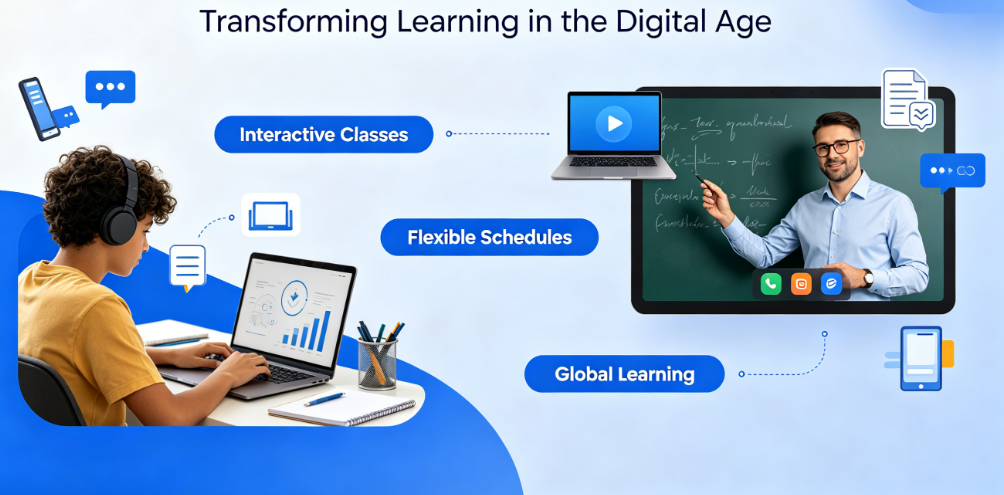
The popularity of online education also brings profound changes to the traditional education model. It breaks the geographical constraints, allowing learners in remote and underdeveloped areas to access high-quality educational resources that were once difficult to reach, promoting the equity of education. At the same time, the flexible learning mode of online education enables learners to arrange learning time and progress according to their own needs, realizing the transformation from “teacher-centered” to “learner-centered” teaching.
However, online education still faces some challenges in its development. On the one hand, the uneven quality of online courses is a prominent problem. Some courses lack professional design and effective supervision, which affects the learning effect of learners. On the other hand, the lack of face-to-face communication between teachers and students may lead to insufficient learning supervision and low learning initiative of some learners. In addition, the digital divide, such as the uneven distribution of network resources and digital devices, also restricts the popularization of online education in some regions.
Looking to the future, online education will develop in the direction of integration, intelligence and refinement. The integration of online and offline education (blended learning) will become the mainstream model, combining the advantages of online education’s flexibility and offline education’s interactivity to improve learning efficiency. With the continuous progress of technology, virtual reality (VR) and augmented reality (AR) will be more widely used in online education, creating immersive learning experiences for learners. At the same time, the supervision of online education will be further strengthened, and the quality of courses will be continuously improved to better meet the learning needs of the public.
In a word, online education, as a new education form driven by technology, has changed the way people learn and promoted the development of education towards more equitable and efficient directions. Although there are still challenges, with the joint efforts of the whole society, online education will surely play a more important role in the future, bringing more opportunities for lifelong learning and personal development.