Renter-Friendly DIY: How to Build a Traceless Air Conditioner Deflector for Japanese Bedrooms
Introduction
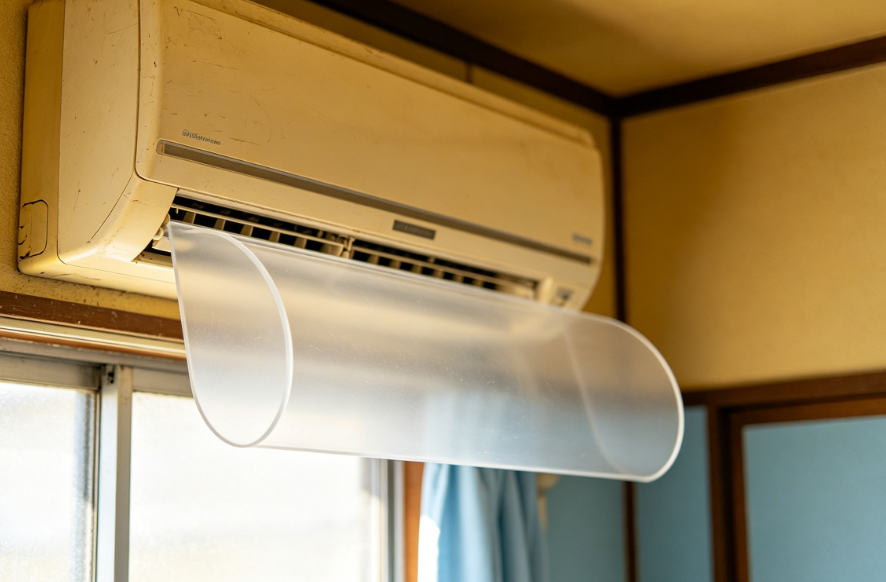
The majority of Japanese rental apartments are equipped with fixed wall-mounted air conditioners with rigid built-in blades. These aging cooling units often blow air directly downward or horizontally without adjustable angles, causing stiff necks, dry skin, and interrupted sleep during prolonged operation. Furthermore, static wind circulation gathers dust inside narrow air outlets, leading to invisible bacteria accumulation. Since tenants are forbidden to drill holes, apply permanent adhesive, or modify air-conditioner shells, adjusting airflow direction becomes nearly impossible. Under such limitations, a handmade removable air conditioner deflector emerges as a mild and practical solution. Made of lightweight transparent plastic and reusable fasteners, this simple tool diverts cold airflow, reduces dust deposition, and softens direct wind impact. Beyond its physical functions, this handmade reflector reflects the subtle Japanese residential principle: reshaping invisible airflow to create a gentler indoor microclimate.
Design Philosophy of the DIY Deflector
Unlike bulky commercial air deflectors with fixed brackets, this handmade version adopts a slim transparent planar structure tailored for shallow Japanese air-conditioner panels. It follows three renter-oriented design logics: zero-surface damage, transparent invisibility, and angle adjustability. Considering Japan’s humid summer climate, the selected plastic material is waterproof, mildew-proof, and easy to wipe clean. Instead of completely blocking wind flow, this deflector gently redirects air circulation to form soft indoor convection. Its minimalist transparent appearance avoids visual obstruction, maintaining the plain wall tone typical of Japanese rental interiors.
Required Materials (Available at Japanese 100-Yen Shops)
- Hard transparent PP plastic sheet (ultra-slim, bendable)
- Clear invisible hanging buckles (residue-free type)
- Soft silicone anti-slip gaskets
- Thin transparent plastic connecting strips
- Round-edged safety cutting scissors
Step-by-Step Fabrication Process
Step 1: Measure Air Conditioner Outlet Size
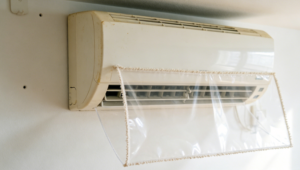
Observe the width and vertical depth of the rental air conditioner’s air outlet. Most Japanese wall-mounted air conditioners possess narrow, compact ventilation grooves. Measure the outer frame and cut the transparent PP plastic sheet into a slightly wider rectangular panel. The extra edge ensures complete wind coverage. Trim all four corners into smooth round arcs to prevent accidental scratching and avoid tearing invisible adhesive buckles during long-term suspension.
Step 2: Bend Plastic Sheet for Wind-Reflecting Radian
Gently bend the flat plastic plate into a subtle curved arc. A moderate radian guides cold air to flow upward and disperse throughout the room, preventing vertical direct blowing. Avoid excessive bending; an overly steep angle will cause turbulent airflow and generate faint wind noise. The plastic material maintains its fixed curvature after manual shaping, requiring no extra metal brackets for support.
Step 3: Install Connecting Strips and Silicone Pads
Attach thin plastic connecting strips to the upper edge of the curved panel. These strips serve as fixed suspension points for later hanging installation. Paste soft silicone gaskets on the inner contact surface. The elastic silicone buffers hard friction between plastic and the air-conditioner shell, protecting the original machine paint and leaving no indentation during long-term use.
Step 4: Fix Invisible Buckles for Traceless Hanging
Paste clear non-residue buckles on the smooth upper edge of the air conditioner panel. Hook the handmade curved plastic board onto the buckles and lightly shake it to test stability. The entire installation relies purely on physical suspension without liquid glue or drilling. When detachment is needed, the buckles can be peeled off cleanly, fully complying with Japan’s strict original-restoration rental regulations.
Daily Usage and Functional Advantages
This handmade air deflector optimizes indoor airflow in multiple practical ways. It lifts cold air upward to achieve uniform room cooling, eliminating freezing direct wind that causes physical discomfort. The smooth transparent panel blocks floating dust from falling into the air outlet, reducing bacterial accumulation in humid summer environments. During Japan’s damp rainy season, it weakens condensed water droplets generated by temperature difference, protecting the air conditioner shell from corrosion. Furthermore, the detachable structure allows users to take down the board effortlessly for regular wiping, simplifying daily sanitation maintenance.
Broader Reflection: Gentle Airflow and Humanized Living
In standardized Japanese rental buildings, air conditioners are uniformly manufactured without personalized wind adjustment. Fixed mechanical wind patterns often ignore human body sensitivity and sleeping postures. This handmade transparent board represents a soft correction to rigid industrial design. Tenants do not modify electrical hardware; instead, they add a thin auxiliary layer to mediate the relationship between humans and machines.
Moreover, this subtle handmade creation cultivates bodily awareness. In air-conditioned modern rooms, people easily overlook invisible wind flow and temperature imbalance. Bending plastic, adjusting angles, and installing buckles encourage renters to perceive subtle indoor air changes. This tiny intervention transforms indifferent mechanical wind into mild, comfortable domestic airflow.
Conclusion
The DIY traceless air conditioner deflector embodies restrained rental wisdom in compact Japanese apartments. With low-cost transparent materials, simple manual bending procedures, and residue-free installation, it solves direct wind irritation, dust accumulation, and uneven cooling problems. It protects human health, maintains appliance cleanliness, and preserves original rental facilities. In limited temporary living spaces, this slim invisible plastic panel proves that comfortable living does not require expensive electrical upgrades. Through subtle handmade modification, renters reshape invisible airflow, creating a balanced, mild, and human-friendly indoor living atmosphere.